
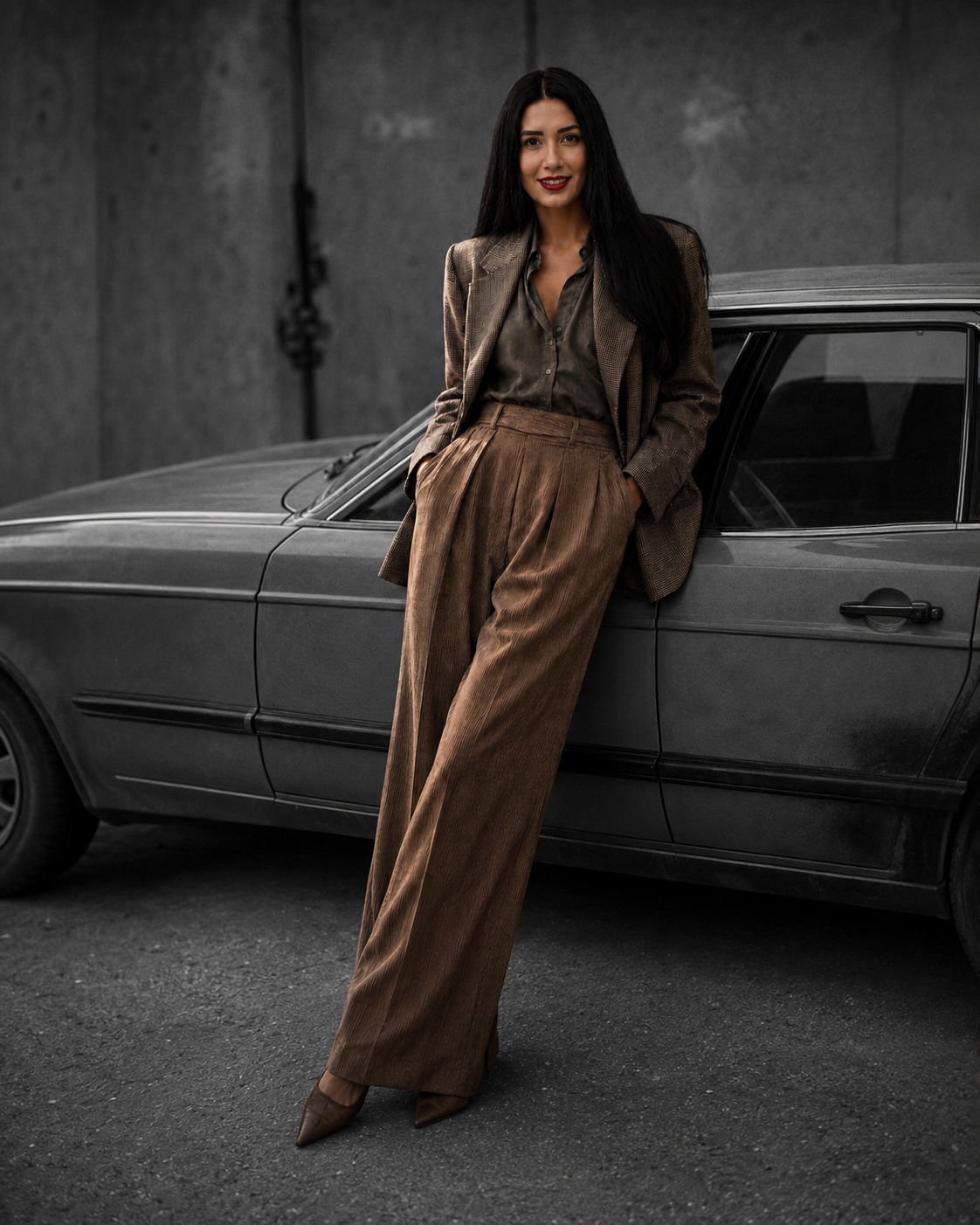
For as long as I can remember, dressing up was never simply about getting dressed.
My earliest lessons in style came from my mother, who approached dressing me with the sort of ceremony usually reserved for a very small debutante. There were carefully considered outfits, particular shoes, the right ribbon, the finishing touch. Long before I had the vocabulary for proportion, fabrication or visual language, I understood that presentation could alter the way a person carried themselves. What began as childhood dress-up eventually became something far more enduring: a fascination with the art of becoming through presentation.
I was the child who flicked through magazines not merely to admire the clothes, but to study them. Why that jacket with that skirt? Why did one woman look impeccably composed in something ostensibly simple while another outfit, despite its expense, somehow missed the mark? Even now, I am instinctively drawn to the well-dressed woman across the room: the one sitting by the window, beautifully composed, whose presence makes you look twice without ever asking you to. I am invariably the woman who catches her eye and smiles in acknowledgement. A small, unspoken salute to the craft.
Because style, to me, has always lived in the details: the weight of a fabric, the fall of a trouser, the tension between textures, the placement of a cuff, the precision of a silhouette. But clothes are only part of the composition.
Presentation without presence is merely decoration.
The way we hold ourselves, the words we choose, the clarity with which we speak, the energy we bring into a room and the intention behind our interactions all form part of the same visual and social language. It is rarely just what someone is wearing that commands attention. It is how they inhabit it.
Perhaps this fascination with presence began early too. Formerly known as “a pleasure to have in class,” I somehow evolved into something of a contradiction: introvert in private, CEO energy in public. Learning to move comfortably between those two states became one of the most formative parts of my career. It taught me that confidence need not be the loudest voice in the room; often it is simply preparation, self-possession and knowing precisely who you are before you enter it.
That understanding helped me progress into leadership earlier than many of my peers, but more importantly, it shaped my philosophy around what it means to be a modern, high-functioning woman of the world: ambitious without becoming performative, polished without becoming contrived, and entirely capable of occupying serious spaces without relinquishing femininity, individuality or delight.
Singhnificance grew from that philosophy.
A play on my name, yes, but also on something I have believed for years: the everyday act of dressing can become a ritual of Singhnificance. Not costume. Not reinvention for the approval of others. Rather, a considered alignment between how you see yourself, how you present yourself and how you wish to move through the world.
My sessions therefore go beyond assembling outfits. We consider silhouette and proportion, certainly, but also context, communication, presence, personal codes and the subtleties that make someone memorable. The objective is not to make you look like somebody else's idea of a well-dressed woman.
It is to refine the visual language of you.
Because the most compelling style is rarely the loudest. It is considered. Intelligent. Precise. And when presentation and presence finally speak the same language, getting dressed becomes something rather more interesting than fashion.
It becomes Singhnificance.